The Holidays Can Be a Pain
The holidays can be a joyous time. You get some time off work, see family and friends, and eat good food. But the holidays also can be a stressful time, perhaps because of interacting with family members with whom we disagree, reminders and memories of a lost loved one, time spent hosting, last-minute shopping for gifts, or wondering whether the effort, the cost, and the compromises will add up to the holiday feeling for which we had hoped. For some people, holiday stress can lead to neuroplastic symptoms. It is often not a coincidence when back pain or other symptoms flare up at this time of year.
Many people with neuroplastic pain or illness suffer for years before they make a full recovery. This is unnecessary today because research-based solutions exist for nearly everyone with this condition. This means we have a communication problem and not a medical one.
One way to view the holidays is to think of them as an opportunity to learn from one another. This can be a time to ensure that loved ones do not continue without answers to their pain or illness. Results from our national study suggest that we have more opportunities to do this than we might have expected. When we asked people how many people they know among their family, close friends, or coworkers have ongoing pain or illness with no clear diagnosis, we found that 51% of US adults said they knew at least one person. When we looked at this question specifically among people who themselves report having ongoing pain or illness with no clear explanation, the number jumps up to 72%. Many said they knew more than one person.
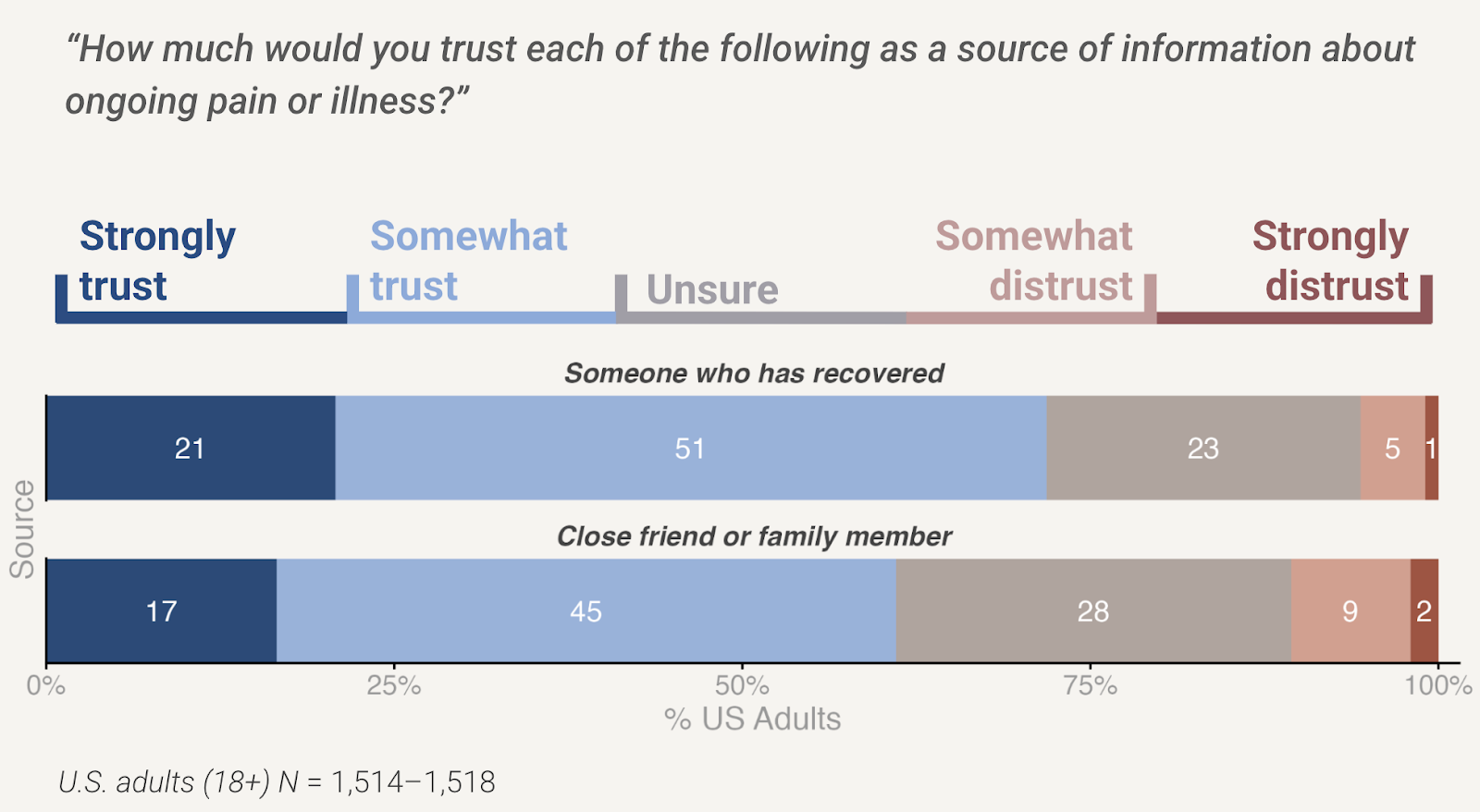
When we look at what people say regarding who they trust as a source of information about ongoing pain and illness, the results are also encouraging. We found that 72% said they “somewhat” or “strongly” trust people who have recovered from their own conditions, and 62% said the same for trust in close friends and family members. This means that many of you reading this might be in a great position to share your wisdom about recovering from neuroplastic symptoms, whether it is back pain, migraines, chronic fatigue, dizziness, or another common condition.
Figure 1: People trust close friends and family, and people who have recovered, as sources of information about ongoing pain and illness
It is still important, as the saying goes, to put your own oxygen mask on first. But if and when you are comfortable, and when the situation is right, it’s worth using the holidays as a time to offer assurance and support for those around you, and receive some of this in return. It doesn’t need to be pushy or high-pressure, just a chance to share experiences and lessons learned with one another. Sometimes a book or podcast recommendation could turn into a life-changing journey through recovery. And that isn’t a far-fetched or rare occurrence. It is something we see very often.
At their best, the holidays bring us back together to create memories and share good cheer. Yet stress and pressure often ramp up, and pain can be what grabs our attention. This season, let connection be the thing that helps you heal. Whether it happens in a meaningful conversation over dinner or a quiet moment of understanding with a friend, remember that relief and hope rarely happen alone. Sometimes the most meaningful gift we can give or receive is simply the belief that recovery is possible. Wishing you a holiday where pumpkin pie gets more of your attention than pain.
Matthew Goldberg, PhD, is Co-founder of XandY—a research and communication strategy firm. David Clarke, MD, is President of the Association for Treatment of Neuroplastic Symptoms. Monique Sondag, BS, is the Strategy and Development Director at the Association for Treatment of Neuroplastic Symptoms.