A life free from chronic symptoms is possible.

SHARING THE NEW SCIENCE OF CHRONIC PAIN & ILLNESS

What are Neuroplastic Symptoms?

Chronic pain or illness not explained by disease or injury (or for which treatment is not working as expected) are usually caused by learned neural pathways in the brain. These are called neuroplastic symptoms.

Upcoming Member Events
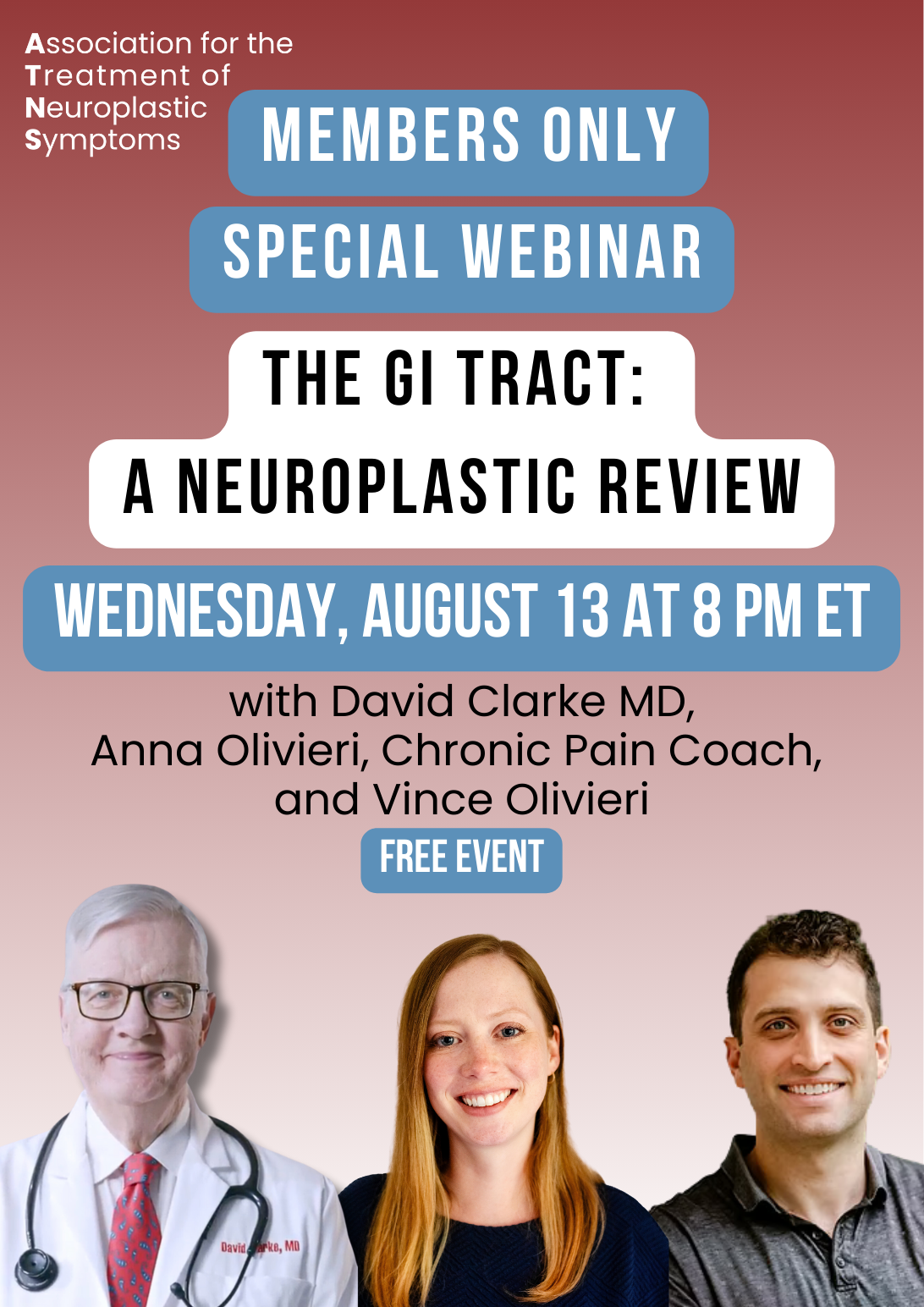
Flyer for a members-only webinar titled 'The GI Tract: A Neuroplastic Review'.

Learn more from the Self-Assessment Questionnaire.

Pain Science Paradigm Shift

Recovery Stories

Watch as the groundbreaking science of chronic pain (and other symptoms) is explained by scientists who did the research, clinicians who put it into practice, and patients who experienced the life-changing benefits.

Advantages of Membership

As an ATNS Member, you gain access to a growing number of evidence-based resources (live events, courses, and much more) that relieve neuroplastic pain or illness. Your support will also help us educate more people about this life-changing new treatment.

Learn More About Membership
Icon of a figure on a computer screen with a play button.
Icon of two speech bubbles with question mark and letter A inside, representing questions and answers.
A black and white cartoon person on the cover of a journal.
A percent sign inside a jagged circle.
A figure of a computer screen with a Zoom meeting.
A silhouette of a person at a lectern speaking to a group.
A figure representing people connecting with each other.
Silhouette of a film camera

Our Board of Neuroplastic Experts

Has Been Featured In

Knowledge Becomes Healing.

Resources

Public
Practitioners

The Future of Pain.

Skeptical?

People with neuroplastic symptoms often can relate to one or more of the following. These can
change with treatment:

  • Excessive Self-Criticism

  • Low Self-Esteem

  • Neglecting your needs

  • Reliability, Focusing on Detail

  • Hard Working

  • Perfectionism

  • Unbalanced or toxic relationships

  • Seeking Approval

  • Stressful lifestyle

  • Poor assertiveness

  • Anxiety

  • Depression

  • Traumatic life event(s)

  • Adversity in Childhood

Common Neuroplastic Conditions

Person holding a SARS-CoV-2 antigen rapid test kit in front of her face, with a visible positive result line.

Long Covid

Young woman with brown hair holding her head with both hands, looking stressed or worried, wearing a gray long-sleeve shirt, against a plain gray background.
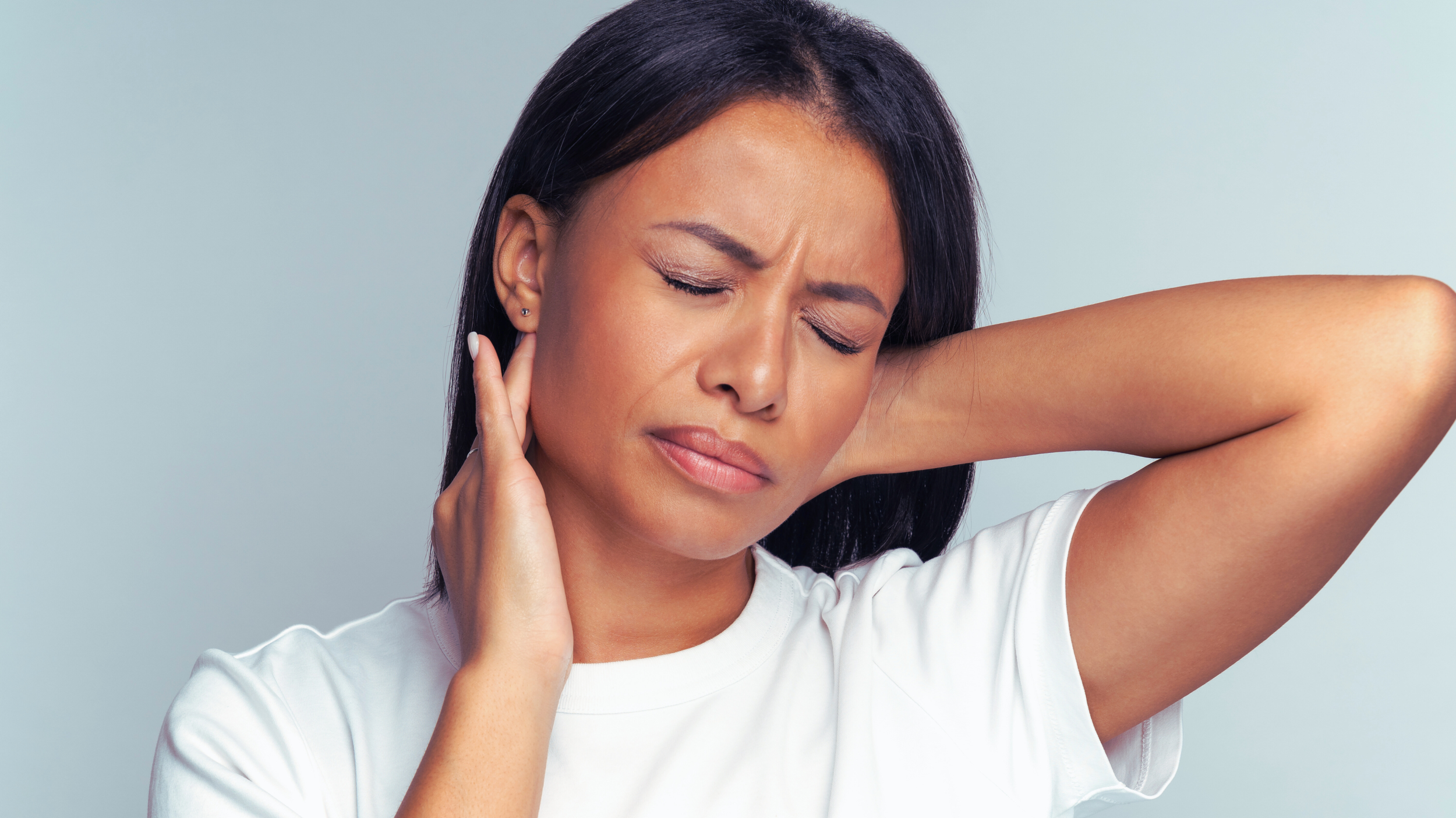
A woman with dark hair holds her neck, appears to be experiencing pain or discomfort, with her eyes closed and a serious expression, wearing a white t-shirt.
A woman with dark hair, wearing a tan top, sitting in a room with her eyes closed, hand on her face, appearing to be in discomfort or pain.
A woman with short gray hair, wearing a light pink t-shirt, is holding her stomach with one hand and leaning against a white wall, appearing to experience stomach pain or discomfort.
A man in a gray long-sleeve shirt experiencing back pain, holding his lower back with one hand and grimacing in discomfort against a light blue background.
A man with a worried expression sitting inside a large cylindrical shape, holding his head with both hands.
Person wearing a gray sweater holding their stomach, indicating stomach pain or discomfort.
A man with a shaved head holding glasses and touching his forehead with eyes closed, appearing distressed or stressed.
A person demonstrating high flexibility of their thumb.
A man holding his right wrist with his left hand, which appears red and irritated.
A woman with dark hair and light skin looking to her left with a contemplative expression, resting her head on her left hand, wearing a beige hoodie and a green beaded bracelet, sitting in front of a wooden wall.
An elderly man clutching his stomach, with one hand on his forehead, shows signs of pain or discomfort.
Person holding their lower abdomen, wearing a white shirt and blue jeans, against a plain yellow background.
Person holding a white piece of paper with a large gray question mark printed on it, standing in front of a plain gray wall.

Other Conditions

A donut chart showing 75% in the center, with yellow and gray segments indicating proportions.

Neuroplastic Recovery Therapies Research

In patients with back pain for an average of 10 years, pain decreased by 75% after eight one-hour sessions of neuroplastic recovery therapy.

A donut chart showing 77% in the center, with four segments in green and gray.

After an average of nine months of long Covid, neuroplastic recovery therapy led to a 77% decrease in pain interfering with activity.

A donut chart showing 67% in the center, with a portion in orange and another portion in dark gray, representing statistical data.

In a study in Los Angeles of older male veterans with chronic pain, 67% achieved at least 30% pain relief with neuroplastic recovery therapy.

A donut chart showing 64% in the center, with blue and dark gray segments.

In a study at Harvard, of people with chronic back pain, 64% became pain-free after six months of neuroplastic recovery therapy.

Did you know?

Group of ten stylized human icons holding hands, with four in blue on the left and six in gray on the right.

4 out of 10 people seen by physicians suffer from neuroplastic conditions.

A logo combining a brain illustration with a light bulb, split vertically to show the brain on the left and the light bulb on the right.

ATNS

The Association for the Treatment of Neuroplastic Symptoms is a 501(c)(3) nonprofit organization with a mission to educate the public, patients, and practitioners about how to diagnose and treat neuroplastic pain and illness. Founded and led by volunteer medical and mental health practitioners, researchers and patient advocates, ATNS provides the information and tools needed to recognize and treat neuroplastic conditions; explains and promotes the latest scientific research; advocates for healthcare policies that support access to quality treatment; and empowers people to advance their own healing.